
Reliable Web Hosting in Canada: A 2026 Buyer's Checklist
Estimated reading time: 8–10 minutes

If your website has ever gone down during business hours, loaded slowly on a customer's phone, or left you waiting two days for a support reply, you already know why hosting matters more than most business owners assume.
Reliable web hosting in Canada means your website stays online consistently (99.9% uptime or better), loads quickly for visitors, keeps your data secure and backed up, and gives you access to support when something breaks. For a small business, that combination is what separates a website that quietly works in the background from one that quietly costs you customers.
This guide walks through what reliability actually looks like, compares the hosting types and providers available to Canadian businesses, and ends with a practical checklist you can use before you sign up with anyone.
At a Glance
- Business Impact: Reliable hosting keeps your site online consistently (99.9%+ uptime), protecting your conversion rates and digital marketing investments.
- SEO & Speed: Server quality directly influences page load times. Slow, overcrowded servers drive up mobile bounce rates and can harm local search rankings.
- Data Security & Privacy: Opting for Canadian-hosted data centers ensures lower latency for your local audience and simplifies compliance with national privacy regulations like PIPEDA.
- The Hidden Costs: Entry-level budget hosting plans frequently hide steep renewal price hikes and bill separately for essential features like automated backups and SSL certificates.
- The Optimal Setup: For active small business websites, a mid-tier managed hosting framework provides the strongest balance of speed, security, and dedicated expert support.
Why Canadian Businesses Need Reliable Web Hosting in 2026
Hosting is one of those decisions business owners make once and rarely revisit, often based on whatever came bundled with a domain purchase years ago. That works fine until it doesn't.
The Real Cost of Downtime for Small Businesses
Every minute your site is down is a minute a potential customer finds a competitor instead. For a local service business, that might mean a lost booking. For an ecommerce store, it's an abandoned cart. Beyond the immediate loss, frequent outages erode the trust customers place in your brand, especially if they land on an error page after clicking a Google ad or a referral link.
Reliability isn't just a technical spec. It's a direct input into whether your marketing spend converts.
Is Your Hosting Quietly Costing You Customers?
Every hour of downtime or slow load time is a missed booking, sale, or lead. Get a free, no-obligation Hosting Health Check from Le Studio WebDesign and find out if your current setup is helping or hurting your business.
How Slow Hosting Hurts Local SEO and Google Rankings
Page speed is a confirmed ranking factor, and it's also one of the clearest signals Google uses to judge user experience. Slow-loading pages hosted on oversold shared servers tend to show higher bounce rates, which can quietly suppress local rankings over time, especially in competitive service areas like Ottawa, Kanata, and Gatineau where several businesses are targeting the same search terms.
If your SEO strategy is solid but your hosting is holding back load times, you're paying for visibility your site can't fully capture.
You can analyze your website's performance using Google PageSpeed Insights, Google's free tool for measuring page speed and identifying opportunities to improve loading times.
Common Hosting Problems We See With Ottawa-Area Clients
Working with small businesses across Ottawa, Orléans, Gloucester, Nepean, Kanata, Gatineau, Rockland, Embrun, and Casselman, a few patterns show up repeatedly: sites hosted on entry-level shared plans that were fine at launch but were never upgraded as traffic grew, WordPress sites slowed down by outdated PHP versions the host never flagged, and businesses who only discover their backups aren't working after a site gets hacked or a plugin update breaks something. None of these are edge cases. They're the normal result of choosing hosting based on price alone, without revisiting it as the business grows.
What Makes Web Hosting "Reliable"? 7 Core Factors
Reliability isn't one thing. It's a combination of measurable factors, and understanding each one helps you compare providers on more than just price.
1. Uptime Guarantees Explained (What % Actually Matters)
Uptime is the percentage of time your site is accessible. A 99.9% uptime guarantee sounds close to 99.99%, but the difference is significant: 99.9% allows for roughly 8.7 hours of downtime per year, while 99.99% allows for about 52 minutes. Look for hosts that publish real uptime data or offer service credits when they fall short, not just a number in their marketing copy.
2. Server Speed and Page Load Times
Speed depends on server hardware, how many other sites share your server, and whether the host uses modern technology like SSD or NVMe storage and caching layers. A host that oversells shared server space to keep prices low will almost always cost you speed.
3. Security Features (SSL, Firewalls, Malware Scanning)
At minimum, reliable hosting should include a free SSL certificate, a web application firewall, and automated malware scanning. For WordPress sites specifically, look for hosts that patch server-level vulnerabilities proactively rather than leaving that entirely to plugins.
4. Data Backup Frequency and Recovery Options
Daily automated backups, stored off-server, are the standard for business-critical websites. The real test isn't whether backups exist, it's how easily and quickly you can restore one. Ask providers directly how restoration works and whether it requires a support ticket or a one-click process.
5. Customer Support Availability and Response Time
When your site goes down, response time matters as much as expertise. Canadian business hours support, live chat availability, and clear escalation paths for urgent issues are worth more than a support team that's technically available 24/7 but slow to respond.
6. Data Center Location and Canadian Data Residency
Hosting your site on Canadian servers can reduce latency for Canadian visitors and matters for businesses handling personal data under Canadian privacy law. This is covered in more detail below.
7. Scalability for Growing Business Websites
A host that works for a five-page brochure site may not hold up once you add ecommerce, a booking system, or a traffic spike from a marketing campaign. Reliable hosting should let you upgrade resources without migrating to an entirely new platform.
What Is the Most Reliable Web Hosting for a Small Business in Canada?
The most reliable option for most small businesses is managed WordPress hosting on Canadian servers, since it combines strong uptime, built-in security, and automatic backups without requiring technical maintenance from the business owner. For businesses with simpler static sites or very tight budgets, quality shared hosting can still be reliable, provided the host doesn't oversell server resources.
Shared Hosting vs. VPS vs. Managed WordPress Hosting
Shared hosting is the most affordable option, with multiple websites sharing one server's resources. It works well for low-traffic sites but can slow down when a neighboring site on the same server spikes in traffic.
VPS (Virtual Private Server) hosting gives you a dedicated slice of server resources, offering more consistent performance and control, but usually requires more technical management.
Managed WordPress hosting is built specifically around WordPress, with automatic updates, built-in caching, staging environments, and support teams who understand WordPress issues specifically rather than general server issues.
Which Hosting Type Fits a Local Service Business Website
For most local service businesses, such as contractors, clinics, salons, and professional offices, managed WordPress hosting offers the best balance: it's reliable enough to not require in-house technical management, while still being affordable at typical small business traffic levels.
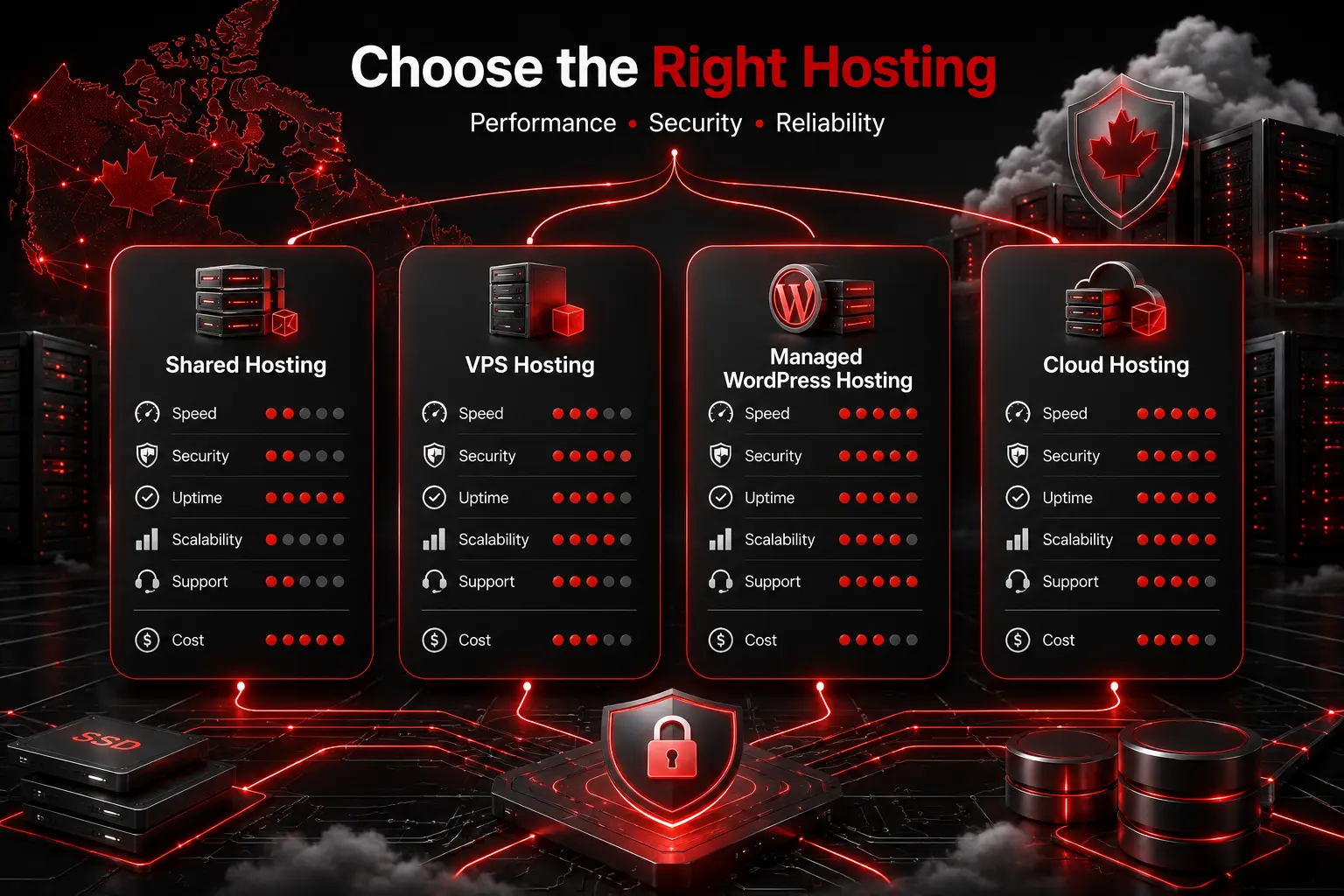
Canadian Web Hosting Providers Compared: Speed, Security, Support, and Price
Comparison Table: Uptime, Server Location, Support, Starting Price
| Hosting Type | Typical Uptime | Server Location | Support | Price (CAD/mo) |
|---|---|---|---|---|
| Budget Shared Hosting | 99.9% (unverified) | Usually US | Ticket support | $3–$8 |
| Standard Shared Hosting | 99.9% | Canada or US | Live chat | $8–$15 |
| Managed WordPress | 99.9–99.99% | Canadian data centers | Chat & Phone | $20–$50 |
| VPS Hosting | 99.9–99.99% | Canadian data centers | Varies | $25–$80 |
Note: Pricing and uptime figures vary by provider and plan tier. Confirm current SLA terms directly with any host before purchasing.
What This Comparison Doesn't Tell You (Hidden Fees, Renewal Rate Hikes)
Introductory pricing is often the first-term rate only, with renewal prices sometimes doubling or tripling after year one. Some providers also charge separately for daily backups, SSL certificates, or migration assistance that competitors include by default. Always check the renewal price and what's bundled in versus billed as an add-on before comparing sticker prices.
Not Sure Which Hosting Tier Is Right for You?
Shared, VPS, or managed WordPress hosting? We'll assess your traffic, growth plans, and budget, then recommend the plan that actually fits, no upsell, no guesswork.
Is Cheap Web Hosting Worth It? Affordable vs. Reliable
Affordable and reliable aren't mutually exclusive, but the cheapest available plan is rarely the most reliable one. Entry-level shared hosting plans are often priced to attract signups, with server resources spread thin across many customers to keep costs down.
What You Sacrifice With Budget Hosting Plans
Budget plans typically mean more websites sharing the same server resources, slower support response times, fewer built-in security features, and backup systems that may not be tested or verified regularly. For a personal blog, that trade-off might be acceptable. For a business generating leads or sales through its website, it's a higher-risk trade.
How to Balance Affordability and Reliability
The most cost-effective approach is choosing a mid-tier managed hosting plan that includes security, backups, and support by default, rather than the cheapest entry plan with add-ons priced separately. Over a year, a $25 to $35 per month managed plan often costs less than a $10 plan plus paid backups, premium support, and the lost business from an outage.
Do You Need Canadian-Hosted Servers for Data Privacy?
Hosting on Canadian servers isn't strictly required by law for most small businesses, but it can simplify compliance with Canadian privacy regulations and typically improves load times for Canadian visitors due to reduced latency.
PIPEDA and Why Data Location Matters for Canadian Businesses
Canada's Personal Information Protection and Electronic Documents Act (PIPEDA) governs how businesses collect and handle personal information, and while it doesn't mandate that data physically reside in Canada, businesses that collect customer data through forms, bookings, or ecommerce checkouts often find it easier to demonstrate compliance and reassure customers when that data is stored on Canadian servers. For businesses serving government clients or handling sensitive personal information, Canadian data residency is increasingly treated as a baseline expectation rather than a bonus feature.
Learn more about Canada's privacy requirements in the official PIPEDA Overview published by the Office of the Privacy Commissioner of Canada.
Canada's data hosting infrastructure is also overseen locally: CIRA (the Canadian Internet Registration Authority), based in Ottawa, manages the .CA domain and works to strengthen the security and performance of Canada's internet, which is part of why Canadian-hosted infrastructure carries real technical and reputational weight for local businesses.
Reliable Web Hosting Checklist: 10 Questions to Ask Before You Buy

Web Hosting Checklist for Canadian Businesses (10-Point Guide)
Use this list when comparing providers side by side. If a host can't give you a clear answer to any of these, treat that as information too.
Skip the Guesswork. Let Us Review Your Hosting.
Not sure if your hosting is the right fit? We'll review your current or prospective hosting and provide a clear recommendation.
Get Reliable, Fully Managed Web Hosting With Le Studio WebDesign
Your content goes here. Edit or remove this text inline or in the module Content settings. You can also style every aspect of this content in the module Design settings and even apply custom CSS to this text in the module Advanced settings.
What's Included in Our Hosting & Maintenance Plans
Looking for a complete solution? Explore our Website Hosting & Maintenance Services to see how we help small businesses keep their websites fast, secure, and reliable. Our plans include Canadian-based hosting options, daily backups, proactive security monitoring, WordPress updates, performance optimization, and responsive technical support. This allows you to focus on running your business while we take care of your website.
Want to understand why ongoing maintenance matters? Read our What Is Website Maintenance? guide to learn how regular updates, monitoring, and backups keep your website performing at its best.
Stop Managing Hosting Headaches Yourself.
Canadian-based servers, daily backups, proactive security, and real support when you need it, all included in our WordPress Care Plans. Ottawa-Gatineau businesses trust us to keep their sites fast, secure, and online.
Frequently Asked Questions About Reliable Web Hosting in Canada
How much does reliable web hosting cost in Canada?
Reliable hosting for a small business website typically ranges from $20 to $50 CAD per month for managed WordPress hosting, though basic shared hosting can start lower with fewer included features and less consistent performance.
Is WordPress hosting different from regular web hosting?
Yes. WordPress hosting is optimized specifically for WordPress sites, with features like automatic core and plugin updates, built-in caching, and support teams trained on WordPress-specific issues, while general hosting is built to run any type of website.
Can I switch web hosts without losing my website?
Yes, with a proper migration your website's files, database, and email can typically move to a new host without data loss, though the process should be planned carefully and backed up beforehand in case anything needs to be restored.
How do I know if my current host is unreliable?
Common signs include frequent downtime notifications, slow page load times confirmed by tools like Google PageSpeed Insights, unresponsive or slow support, and backups that either don't exist or have never been tested.
Does hosting affect my Google ranking?
Yes, indirectly. Hosting affects page speed and uptime, both of which influence user experience signals that Google factors into rankings, meaning poor hosting can quietly limit how well an otherwise well-optimized site performs in search.
Google's SEO Starter Guide explains how website quality, performance, and user experience contribute to better search visibility.